

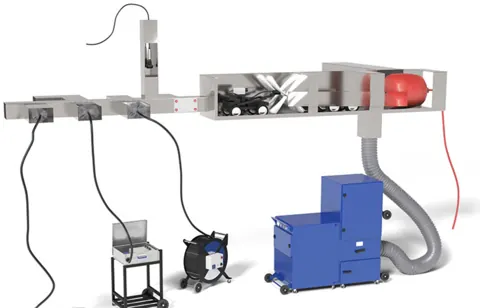
This step by step plan is written for facilities and maintenance teams, installers and cleaning contractors who carry out the work themselves. It follows the line of the European standard EN 15780:2025, the recommendations of Eurovent and the American NADCA standard ACR 2025, with sources and a check date of 6 October 2026.

Step 1: inspection and survey of the duct network
Every job starts with looking. With a camera system you map how dirty the ducts are, where bends, dampers and silencers are located and which material is installed. Where needed you take wipe samples. Cleaning contractors assess that inspection against EN 15780 and against the insurer's requirements and record it in a photo report.
During the survey, pay attention to access. Eurovent advises inspection openings no more than 10 m apart or after no more than two bends of 45 degrees or more. Ducts larger than 500 mm need a hatch of at least 500 × 400 mm, and there should be an opening on both sides of dampers, coils, MVHR units, silencers, filters and fans.
The NADCA standard ACR 2025 also requires a scope of work with a safety plan. It states who does what, which rooms are out of use and how you prevent dust from spreading.
Step 2: sealing valves and closing off duct sections
Before any brush turns, you close off the section you are cleaning from the rest of the building. With duct sealing balloons you shut off a duct section during cleaning or inspection. Foam caps seal valves and diffusers, so that loosened dust does not enter the room. If access points are missing, you fit resealable access hatches or small access doors.
For this, look at the vent caps for duct cleaning in the sealing and extraction category. Work in sections: seal, clean, check and only then move on to the next part.
Step 3: building up negative pressure with HEPA filtration
The most important principle in every professional duct cleaning method: the section you are cleaning is under continuous negative pressure. An extraction unit draws air out of the duct, so that loosened dust goes to the unit and not to the workplace.
- If the extraction unit exhausts inside the building, a HEPA filter of 99.97% at 0.3 µm is required according to the University of Maryland specification.
- The American EPA mentions exhausting to the outside as an alternative.
- Danduct Clean supplies VT extraction fans with hoses and filtration for this purpose.
Negative pressure is switched on before you start and only switched off once the section has been checked. A practical tip: mark on your duct drawing which sections are already under negative pressure, so that a colleague never starts brushing a section that is still open to the room.
Step 4: cleaning with a rotating brush or compressed air
The method follows from the inspection. According to Eurovent, dry methods are usually sufficient for supply and general extract; extract from commercial kitchens requires a wet method.
| Method | When | Example from the range |
|---|---|---|
| Rotating brush, electric | long ducts 100 to 600 mm, round and rectangular, up to 30 m, vertical sections and bends | DC4 |
| Rotating brush on a power drill | small ducts, short runs, shaft 2.5 to 7.5 m | PD4 |
| Compressed air with camera | ducts from 30 mm, tight 90 degree bends, places a brush cannot reach | Intelligent Airnozzle |
| Wet cleaning | grease in extract from commercial kitchens | depends on the system |
| Manual | accessible parts, grilles, valves | brushes and cloths |
With the DC4 duct cleaning machine for cleaning contractors you feed the shaft into the duct, and the automatic left and right system changes the direction of rotation in time. Drill driven duct cleaner is intended for smaller ducts. Where you need to get round a corner, choose air nozzle duct cleaning: the Airnozzle requires a compressor of 700 L/min or more at around 10 bar. You choose the brush based on the duct material: soft for fibreglass duct board and sheet metal, more aggressive for stubborn dirt. More on that under air duct brush.
Step 5: checking and measuring after cleaning
Clean is only clean when you can prove it. The common ways:
- Surface comparison: comparing visually or with a camera against a reference.
- NADCA vacuum test: a gravimetric measurement of the dust per surface area.
- Dust density measurement: in German hospital practice under VDI 6022, by inspectors with category A training.
- Grease layer measurement: with a wet film thickness gauge, according to the NVRL quality mark scheme with a sample behind every extract hood and every 10 m of duct; after cleaning a maximum of 200 µm.
For dust, trade publications mention limit values of 0.6, 3.0 and 4.5 g/m² per quality class. Which value applies to your building is explained under rules for clean ductwork.
Step 6: reporting and a file for the client and insurer
The report is the product the client keeps. KHN (Royal Dutch Hospitality Association) states that a clean hospitality duct must be demonstrable with reporting, photos and a certificate. A complete report contains:
- the scope of the work with a diagram of the duct network;
- photos before and after for each section;
- measured values before and after, with the measuring method;
- deviations, such as damaged ducts or missing hatches;
- advice for the next inspection.
For care facilities, a German laboratory advises having cleaning and hygiene inspection done by different parties, for objectivity. Set the next moment based on the interval for ventilation duct cleaning that suits the building.
Duct cleaning procedure: checklist for your project plan
| Checkpoint | Done |
|---|---|
| Camera inspection carried out and contamination recorded | ✓ / ✗ |
| Scope of work with safety plan drawn up | ✓ / ✗ |
| Inspection hatches present or fitted | ✓ / ✗ |
| Valves sealed, duct section closed off | ✓ / ✗ |
| Negative pressure active, HEPA or exhaust to the outside | ✓ / ✗ |
| Brush or method suited to material and dirt | ✓ / ✗ |
| Measurement after cleaning carried out and recorded | ✓ / ✗ |
| Report with photos handed over | ✓ / ✗ |
Use the checklist per section rather than per building: a large building can have a section that is finished and a section that still waits for hatches. If you are missing equipment for any of these steps, see which ventilation duct cleaning tools suit your ducts.
Common mistakes when cleaning ducts professionally
- No negative pressure: the dust comes loose and spreads through the building.
- Wrong brush: a brush that is too hard can damage fibreglass duct board; the EPA advises soft brushes.
- Biocides without reason: according to the EPA, no biocides are registered for fibreglass duct board and coatings are not routinely needed.
- Compressed air in dusty production areas: in bakeries, Alimento and TNO advise against compressed air for cleaning the room; for ducts under negative pressure the situation is different, but consult your occupational health and safety adviser. See also flour dust in bakery ducts.
- No measurement afterwards: without a measurement you cannot defend the result.
For simple residential systems, part of the work can be done by the occupant. Where that boundary lies is explained under cleaning ventilation ducts yourself.
Air duct cleaning equipment from Lamers at a glance
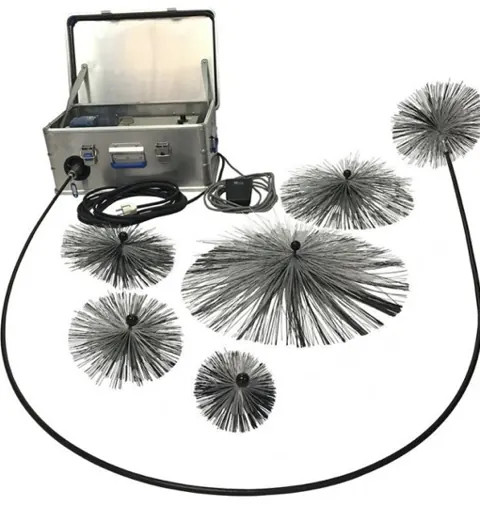 DC4 duct cleaning machineDC4: electric, up to 30 m, ducts from 100 to 600 mm
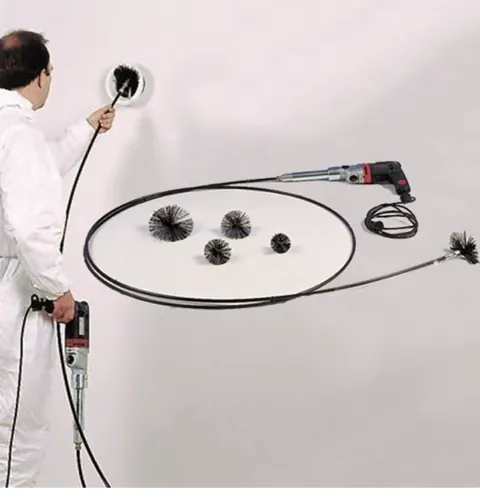 PD4 duct cleanerPD4: runs on a power drill, shaft 2.5 to 7.5 m
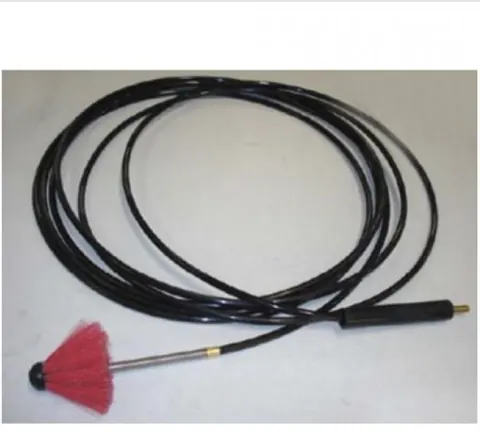 PD2 duct cleanerPD2: compact duct cleaner, specifications via Lamers
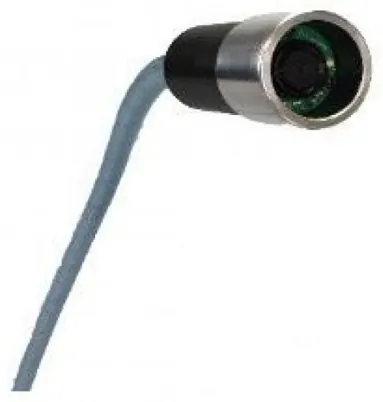 Intelligent AirnozzleCompressed air with camera, ducts from 30 mm
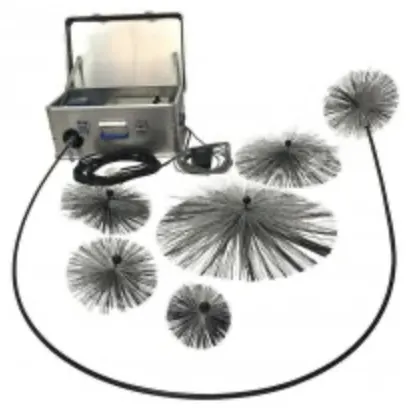 Duct cleaning brushesBrushes and shafts: soft, standard or Tynex
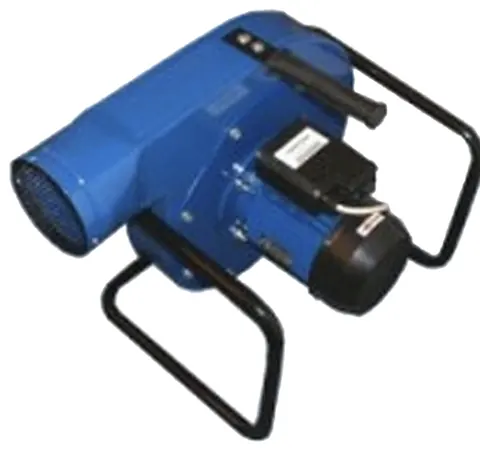 Duct sealing and extractionDuct balloons, diffuser caps and extraction
Frequently asked questions: air duct cleaning process
How can I clean my air ducts without spreading dust through the building?
Close off the duct section with sealing balloons, seal the valves with foam caps and keep the section under continuous negative pressure with an extraction unit. If that unit exhausts indoors, use a HEPA filter of 99.97% at 0.3 µm, or exhaust the air to the outside. Only then do you start brushing or using compressed air.
Why does a professional duct cleaning plan start with a camera inspection?
A camera shows how dirty the duct is, which material is installed and where bends and dampers are located. On that basis you choose the method, brush and order. Moreover, according to KHN severe contamination is often not visible to the naked eye. The footage also forms the baseline measurement for your report afterwards.
Which filter rating does an extraction unit need when it exhausts inside the building?
The University of Maryland specification then requires a HEPA filter with an efficiency of 99.97% for particles of 0.3 µm. Without such a filter you blow fine dust from the duct straight into the work area. The American EPA mentions exhausting to the outside as an alternative to HEPA filtration.
When do you choose compressed air instead of a rotating brush for an air duct?
For small ducts from 30 mm and tight bends that a brush shaft cannot get through. Lamers notes that an air nozzle was long considered less effective than rotating brushes, but that with the built-in camera of the Intelligent Airnozzle you see and clean every spot and corner.
How do you check after brushing whether an air duct is really clean?
With a surface comparison by camera or with a gravimetric measurement such as the NADCA vacuum test. In kitchen extraction you measure the grease layer with a wet film thickness gauge. Record every measurement with location, method and value, so that the client can check the result and compare it at the next round.
What belongs in a report after cleaning air ducts?
A diagram of the duct network, photos before and after for each section, measured values before and after with the method used, deviations found and advice for the next inspection. For hospitality, KHN mentions reporting, photos and a certificate as evidence that the duct is clean, including towards the fire insurer.
How many measuring points do you take for a grease layer measurement in kitchen extract ducts?
The NVRL quality mark scheme requires a sample behind every extract hood and also one per 10 metres of duct, measured with a wet film thickness gauge with an accuracy of 20 µm. The intervention value is 500 µm, and after cleaning the grease layer may be at most 200 µm to meet the performance value.
May you apply biocides or coatings in air ducts after cleaning?
Be cautious. The American EPA reports that no biocides are registered for fibreglass duct board and that coatings are not routinely needed. Cleaning removes the cause, while a product often only masks it. Only use a product if the inspection gives a clear reason for it, and record that reason.
What do you do if the inspection shows the duct network has too few hatches?
Then you first fit resealable inspection hatches or small access doors before you start cleaning. As a guideline, the Eurovent recommendation applies: an opening every 10 metres or after two bends of 45 degrees or more. Include those extra hatches in the planning and the quote, because they cost time and material.
Why would you assign duct cleaning and hygiene inspection to different parties?
For objectivity. A German laboratory advises not letting the party that cleans also assess the result. If your own maintenance team carries out the cleaning, you can have the measurement afterwards or the hygiene inspection done externally. That gives you an independent judgement for a care inspection, insurer or quality mark.
Sources and reference date
All facts on this page were checked on 6 October 2026.
- Eurovent REC 6/7: cleanliness of ductwork
- University of Maryland: duct cleaning specification
- NADCA: ACR 2025
- EPA: should you have air ducts cleaned?
- NVRL quality mark scheme for cleanliness (Binnenklimaattechniek) (in Dutch)
- Danduct Clean: accessories
- Lamers: Intelligent Airnozzle (in Dutch)
- Hamster Cleaning: inspection (in Dutch)
Editorial team: Lamers Reinigingstechniek B.V., supplier of professional air duct cleaning equipment in Zelhem, the Netherlands. Updated on . See also Lamers from Zelhem for cleaning contractors.
Request a quote or advice from Lamers

René Hendriksen, Sales Account Manager at Lamers, advises you on the machine, brushes and extraction for your jobs.
Briefly tell us what you clean (duct type, diameter, length, contamination and sector). Lamers will contact you with advice and a tailored quote.
Prefer direct contact? Call +31 (0)314 623 341, message us on WhatsApp 06-38048347 or email info@lamersequipment.nl.
Prefer a quick call first? Lamers will call you back

Leave your number. René Hendriksen or a colleague from Lamers will call you back to discuss duct type, diameter and the right equipment.
Or send us a message right away: WhatsApp 06-38048347