

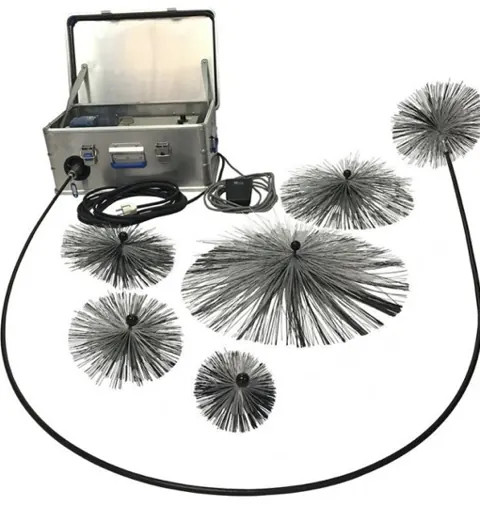
You feed the shaft into the duct and the machine does the rest: it automatically rotates left and right at an adjustable interval, with variable speed. The DC4 runs on standard 230 volts and is available from Lamers Reinigingstechniek in Zelhem, the Netherlands, with advice on the package and brushes.


What does the DC4 duct cleaner do in practice?
The core of the DC4 is simplicity. The machine drives a steel spool and drive shaft with a rotating brush at the end. According to Lamers, that light, solid shaft keeps the brush in the centre of the duct, so the brush touches the wall all the way round.
The automatic left to right system changes the direction of rotation at an interval you set yourself. That way the brush works over the duct wall in both directions. You adjust the speed to the duct: slower in delicate material, faster for heavy deposits in steel ducts.
Because the DC4 also handles vertical ducts and 90 degree bends, you need to cut an extra opening less often to reach a run. That saves work in buildings where the ducts run above suspended ceilings or in shafts.
Specifications of the Danduct Clean DC4 at a glance
| Feature | DC4 |
|---|---|
| Manufacturer | Danduct Clean, Herning (Denmark) |
| Duct diameter | 100 to 600 mm |
| Duct shape | Round and square |
| Reach | Up to 30 metres |
| Vertical ducts | ✓ |
| 90 degree bends | ✓ |
| Direction of rotation | Automatic left and right, adjustable interval |
| Speed | Variable |
| Brushes | Polypropylene 0.6 and 0.9 mm |
| Power supply | Standard 230 volts |
| Camera | ✗ not built in |
| Price | By quote via Lamers |
Source: Lamers and Danduct Clean, reference date 6 October 2026. Request any other technical data from Lamers.
Use this table as a starting point for your own checklist. Put your largest and smallest duct size, your longest run and the type of dirt next to each line, and you can see at once which points need a question to Lamers before you order.
DC4 duct cleaner packages: Medium or Large?
Manufacturer Danduct offers the DC4 in two configurations. Which one fits depends mainly on the length of your runs and how often you encounter stubborn deposits.
| Component | Medium | Large |
|---|---|---|
| DC4 machine | ✓ | ✓ |
| Shaft 10 metres | ✓ | ✓ |
| Shaft 20 metres | ✓ | ✓ |
| Shaft 30 metres | ✗ | ✓ |
| Trolley | ✗ | ✓ |
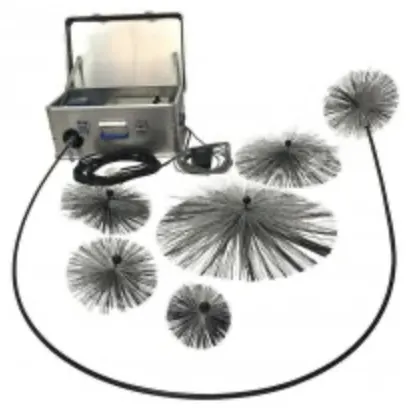
| Brush set of 7, 100 to 600 mm | ✓ | ✓ |
| Aggressive brush set of 7 | ✗ | ✓ |
| Shaft holder | ✗ | ✓ |
If you mainly work in offices with runs up to 20 metres and dry dust, Medium is often a logical start. Cleaning contractors who work in a variety of buildings and want to use the full 30 metres tend to look at Large. Individual brushes in normal, soft and Tynex and the DC4 Sprayer System are available separately.
Which brushes go with the DC4 duct cleaning machine?
The brush determines what you get out. Danduct supplies three types:
- Soft: for delicate ducts. The EPA recommends soft brushes for fibreglass duct board and for sheet metal.
- Normal: the standard for dry dust in supply and exhaust ducts.
- Tynex: more aggressive, for stubborn deposits in sturdy steel ducts.
Choose a brush diameter that matches the duct: too small and you do not touch the wall all round, too large and the brush runs heavily. In square ducts, pay attention to the corners. If in doubt, read how to select brushes for air ducts.
Working with the electric brushing machine in six steps
- Survey the run. Locate the openings. Eurovent recommends inspection openings no more than 10 metres apart, or with no more than two bends of 45 degrees or more between them.
- Seal off. Cover valves and diffusers with foam caps and seal the duct section with a balloon.
- Create negative pressure. Connect an extraction unit and keep the section under continuous negative pressure. If the unit exhausts indoors, use HEPA at 99.97 percent at 0.3 µm. How that works is explained under duct sealing and extraction.
- Choose shaft and brush. Take the shaft that is just long enough and a brush that matches the diameter and material.
- Clean. Set the reversing interval and speed, feed in the shaft and let the DC4 do its work. Pull back slowly so the loosened dirt travels towards the extraction.
- Check. Record the result with a camera inspection or a surface comparison.
The complete process, including reporting, is described in air duct cleaning step by step.
Which buildings and sectors is the DC4 suitable for?
The range of 100 to 600 mm covers most ducts in commercial and public buildings. A few examples where the DC4 is a good fit:
- Offices and business premises: long supply ducts above the ceiling. See ventilation in commercial buildings.
- Schools: the Netherlands Enterprise Agency (RVO) points out that ducts in newly completed schools may be contaminated with construction dust. More under ventilation ducts in school buildings.
- Care: where an air management plan with maintenance and periodic checks is required. Read air duct cleaning in care homes.
- Hotels: vertical exhaust ducts, which according to the manufacturer the DC4 can also handle.
Fictional example: after a school building has been completed, an installer cleans the 315 mm supply ducts. For each run of about 20 metres he sets up negative pressure, cleans with the DC4 and a normal brush, and records with camera images that the construction dust has gone.
DC4, PD4 or Airnozzle: when do you choose the DC4 duct cleaner?
| Question | DC4 | PD4 | Airnozzle |
|---|---|---|---|
| Run longer than 7.5 m | ✓ up to 30 m | ✗ | ✓ 20 m hose |
| Duct thinner than 100 mm | ✗ | ✗ | ✓ from 30 mm |
| Own motor, no power drill needed | ✓ | ✗ | Compressor needed |
| Vertical ducts | ✓ | Ask Lamers | Ask Lamers |
| Image while cleaning | ✗ | ✗ | ✓ |
If you work mostly in short sections, look at the compact PD4 duct cleaner. For thin ducts with a camera, compressed air duct cleaning is a useful addition. All machines are side by side when you compare duct cleaning kits.
Spray system and greasy ducts: what should you watch for?
Danduct offers a spray system for the DC4, the DC4 Sprayer System. According to the Eurovent recommendation, dry methods are usually sufficient for supply and general exhaust, but exhaust ducts from commercial kitchens call for wet methods.
For restaurant and catering kitchens there are also grease layer limits. The NVRL and TNO quality mark scheme uses an intervention value of 500 µm of grease and a performance value after cleaning of no more than 200 µm. Whether the DC4 with spray system and Tynex brushes suits your kitchen ducts is best discussed with Lamers beforehand. More background under removing grease from kitchen extraction.
Ready to choose? You can get in touch with Lamers with a quote request, a callback request or a question.
Air duct cleaning equipment from Lamers at a glance
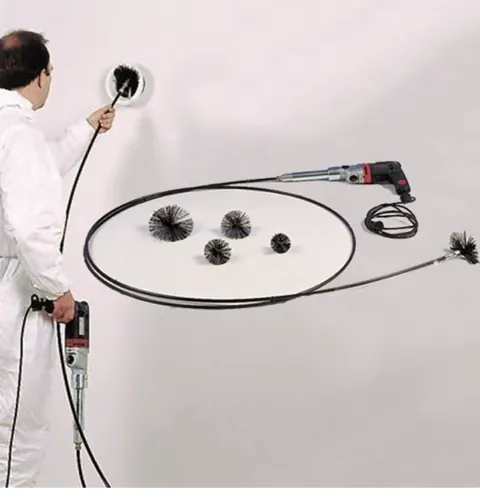 PD4 duct cleanerPD4: runs on a power drill, shaft 2.5 to 7.5 m
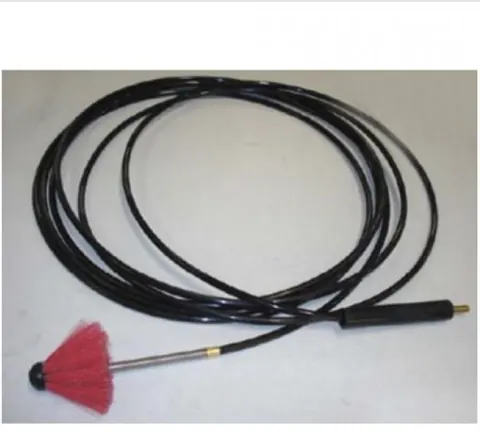 PD2 duct cleanerPD2: compact duct cleaner, specifications via Lamers
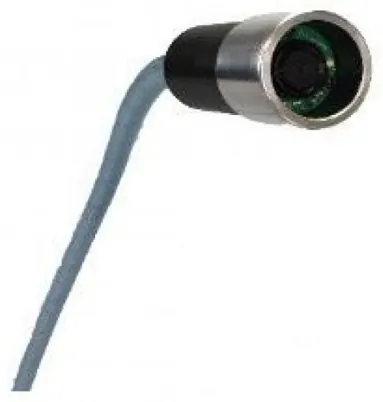 Intelligent AirnozzleCompressed air with camera, ducts from 30 mm
 Duct cleaning brushesBrushes and shafts: soft, standard or Tynex
 Duct sealing and extractionDuct balloons, diffuser caps and extraction
Frequently asked questions: DC4 duct cleaning machine
How far does the DC4 duct cleaning machine reach into a duct?
The DC4 reaches up to 30 metres. For that you do need a 30 metre shaft, which comes as standard in the Danduct Large package. The Medium package has shafts of 10 and 20 metres. Bear in mind that bends and vertical sections make the work heavier than a straight run.
Which duct diameters can the Danduct Clean DC4 clean?
The DC4 is made for ducts from 100 to 600 mm, both round and square. The brush set in the packages consists of 7 brushes that together cover that range. For ducts thinner than 100 mm, the Intelligent Airnozzle is more suitable, as it works from 30 mm.
Can the DC4 duct cleaner go through vertical ducts and bends?
Yes. According to Lamers and Danduct, the DC4 also cleans vertical ducts and 90 degree bends. The solid steel shaft keeps the brush in the centre of the duct while doing so. For a run with many consecutive bends, it is wise to check the route with a camera beforehand.
Why does the DC4 rotate automatically to the left and right?
The automatic left to right system changes the direction of rotation at an interval you set, so the brush works over the duct wall in both directions without you having to switch manually. You set the reversing interval and the speed yourself, so you can match the machine to the duct material and the level of contamination.
What power supply does the DC4 brushing machine use?
The DC4 runs on standard 230 volts. So you do not need three phase power or a compressor, just an ordinary socket near the opening where you are working. The extraction unit that keeps the duct under negative pressure does need its own power connection.
Which brushes do you use with the DC4 on fibreglass duct board?
Use a soft brush on fibreglass duct board. The EPA recommends soft brushes for this material and for sheet metal to prevent damage. Danduct supplies soft, normal and Tynex brushes for the DC4. The Tynex version is more aggressive and is meant for stubborn deposits in sturdy steel ducts.
What is the difference between the DC4 Medium and Large packages?
Medium contains the machine, shafts of 10 and 20 metres and a brush set of 7. Large adds a 30 metre shaft, a trolley, an aggressive brush set of 7 and a shaft holder. If you often deal with long runs or many different buildings, Large is usually the better fit.
Is the DC4 suitable for greasy kitchen extract ducts in restaurants?
That depends on the grease layer. According to Eurovent, kitchen exhaust requires wet methods, and Danduct offers a spray system for the DC4. The NVRL quality mark scheme sets the intervention value at 500 µm of grease and the value after cleaning at no more than 200 µm. Discuss your situation with Lamers beforehand.
Does the DC4 duct cleaning machine have a built-in camera?
No, the DC4 is a brushing machine without a camera. If you want to see how dirty a duct is or record the result, combine the DC4 with an inspection camera or with the Intelligent Airnozzle, which does have a camera with LED lighting. Danduct also has separate inspection cameras in its range.
What does a DC4 duct cleaning machine cost at Lamers?
Lamers does not publish a fixed price for the DC4. The price depends on the package, shafts and brushes you choose. So request a quote and provide your duct sizes, run lengths and type of contamination. You will then receive an offer that fits your work.
Sources and reference date
All facts on this page were checked on 6 October 2026.
Editorial team: Lamers Reinigingstechniek B.V., supplier of professional air duct cleaning equipment in Zelhem, the Netherlands. Updated on . See also about Lamers Reinigingstechniek.
Request a quote or advice from Lamers

René Hendriksen, Sales Account Manager at Lamers, advises you on the machine, brushes and extraction for your jobs.
Briefly tell us what you clean (duct type, diameter, length, contamination and sector). Lamers will contact you with advice and a tailored quote.
Prefer direct contact? Call +31 (0)314 623 341, message us on WhatsApp 06-38048347 or email info@lamersequipment.nl.
Prefer a quick call first? Lamers will call you back

Leave your number. René Hendriksen or a colleague from Lamers will call you back to discuss duct type, diameter and the right equipment.
Or send us a message right away: WhatsApp 06-38048347